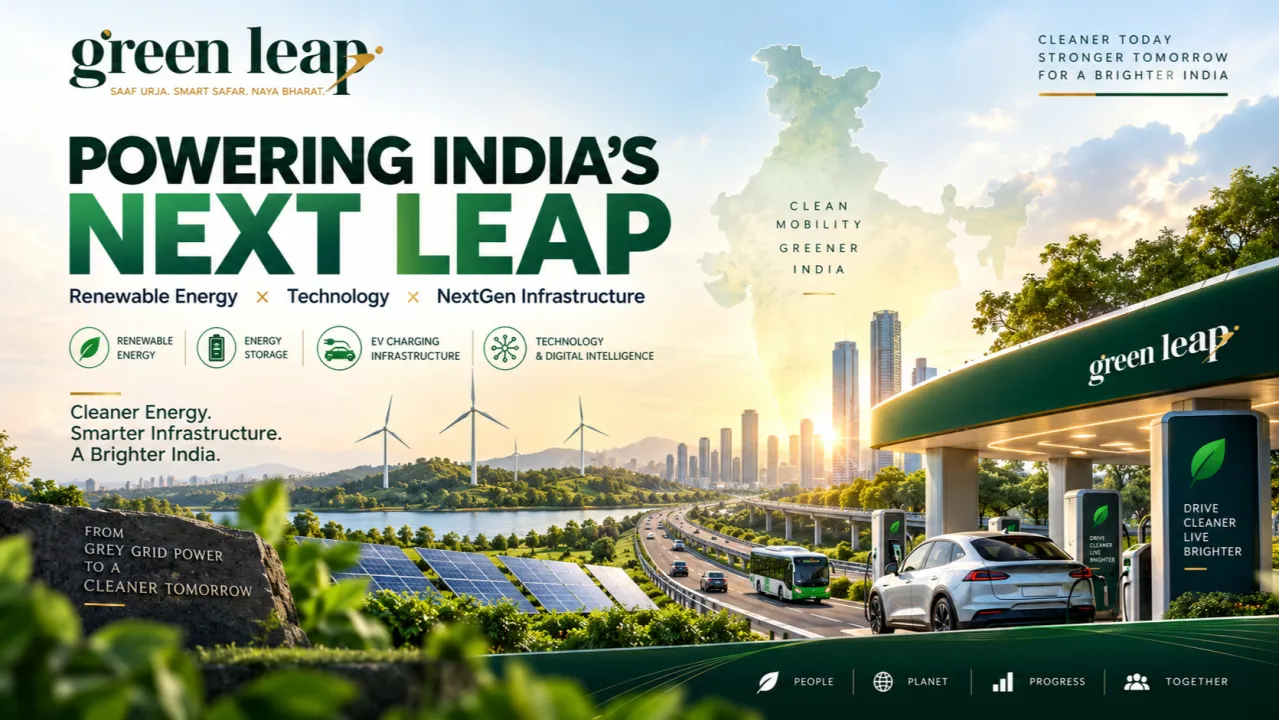
India is at a defining moment in its development journey.
Over the next decade, our nation will not only build new cities, industries, highways and digital networks—it will build the energy infrastructure that powers India’s next phase of economic growth.
Renewable energy will be central to this transformation.
But India’s opportunity goes far beyond adding solar and wind capacity. The real opportunity is to build an integrated infrastructure ecosystem where clean energy, energy storage, electric mobility and digital technology work together.
That is the foundation of India’s next leap.
From Energy Transition to Infrastructure Transformation
India’s renewable-energy journey is already gathering remarkable momentum.
As of 31 August 2026, India had approximately 295.6 GW of installed renewable-energy capacity, including around 168 GW of solar and 58.5 GW of wind capacity.
These numbers represent significant progress.
But capacity alone is not the destination.
India has set an ambitious goal of achieving 500 GW of non-fossil-fuel capacity by 2030. Achieving this ambition will require us to think beyond generation and build the infrastructure that can efficiently integrate, store, distribute and consume clean energy.
We must therefore ask:
How do we generate clean energy? How do we store it? How do we distribute and manage it intelligently? How do we bring clean power closer to consumers? And how do we connect it to the industries, businesses, communities and mobility systems of tomorrow?
The answer lies in integrated, technology-enabled infrastructure.
The Next Opportunity: Connecting Energy With Demand
The next phase of India’s energy transition will increasingly be about connecting renewable generation with where energy is actually consumed.
- Factories can generate and store clean power.
- Commercial buildings can become energy-producing assets.
- Industrial parks can integrate renewable generation and storage.
- Highways can evolve into clean-energy corridors.
- EV charging hubs can become intelligent energy nodes.
This is where the concept of distributed and intelligent energy infrastructure becomes critical.
The future will not be defined simply by how much energy we generate.
It will be defined by how intelligently we generate, store, distribute and use it.
Energy Storage: The Missing Link
As renewable energy becomes a larger part of India’s energy mix, energy storage will become increasingly important.
Solar and wind generation are inherently variable. Storage provides the flexibility required to balance supply and demand, improve reliability and maximise the utilisation of renewable energy.
The scale of the opportunity is significant.
The Central Electricity Authority estimates that India could require approximately 73.93 GW / 411.4 GWh of energy-storage capacity by 2031–32 to support the integration of large-scale renewable generation.
This creates a major opportunity across:
- Battery Energy Storage Systems
- Pumped-storage projects
- Distributed storage
- Commercial & industrial storage
- Renewable-plus-storage projects
- Smart energy-management systems
Storage should therefore not be viewed simply as a backup technology.
It is becoming a core component of India’s future energy infrastructure.
Renewable Energy Is an Economic Opportunity
The renewable-energy transition is not only an environmental imperative.
It is one of India’s most significant economic and industrial opportunities.
It can create new industries, technology capabilities, skilled employment and globally competitive Indian businesses.
The opportunity extends across the value chain:
- Renewable-energy generation
- Energy storage and battery systems
- EV charging infrastructure
- Power electronics
- Smart-grid technologies
- Digital energy platforms
- Green mobility
- Distributed energy systems
- AI-enabled energy optimisation
- Infrastructure financing
- Operations and maintenance
The companies that succeed in this transition will not simply manufacture or deploy individual products.
They will integrate technologies, infrastructure and customer needs into scalable solutions.
That is where innovation can create lasting economic value.
Technology: The Force Multiplier
Renewable energy provides the foundation.
Technology provides the intelligence.
AI, IoT, cloud platforms, advanced analytics, smart meters, predictive maintenance and intelligent energy-management systems can fundamentally change how energy infrastructure is designed and operated.
Consider the charging station of the future.
It will do more than charge a vehicle.
It can understand energy demand, optimise charging, identify renewable-energy availability, coordinate with battery storage, respond to grid conditions and provide real-time energy insights.
A charging station can therefore evolve from a point of consumption into an intelligent energy node.
This is the transition from:
Static Infrastructure → Intelligent Infrastructure
And this transition will be fundamental to India’s energy future.
The EV Revolution Needs a Clean-Energy Backbone
India’s electric-mobility opportunity is enormous.
Public charging infrastructure is expanding rapidly. Government data reported 52,718 public EV charging stations as of July 2026, including 16,561 public charging stations equipped with fast chargers for cars.
But building more charging points is only one part of the solution.
The next challenge is to make charging infrastructure:
Accessible. Reliable. Scalable. Intelligent. Renewable-powered.
The charging network of tomorrow should not be viewed simply as a network of charging points.
It should become an integral part of India’s clean-energy infrastructure.
Highways, cities, workplaces, commercial centres, logistics parks and residential communities can evolve into interconnected clean-energy and mobility nodes.
This convergence creates a new infrastructure opportunity:
Clean Energy Mobility Infrastructure
An ecosystem combining renewable generation, energy storage, EV charging and digital intelligence can support cleaner mobility while improving energy resilience and utilisation.
Turning Opportunity Into Action
India has the opportunity.
But transformation requires execution.
1. Design for Integration
Renewable energy, storage, mobility and digital infrastructure should be planned as interconnected systems—not isolated projects.
2. Accelerate Renewable-Powered Mobility
EV charging infrastructure should increasingly integrate renewable energy and storage to maximise the environmental benefits of electrification.
3. Build Energy-Storage Capacity
Storage must become an integral part of India’s renewable-energy and grid-modernisation strategy.
4. Enable Open & Interoperable Systems
Energy and mobility platforms must communicate seamlessly.
Interoperability will be critical for scale, reliability and customer experience.
5. Encourage Private Innovation
India needs entrepreneurs and enterprises willing to develop, finance and deploy next-generation infrastructure at scale.
6. Build Future-Ready Talent
The clean-energy economy will require professionals who can combine engineering, technology, energy, finance, data and infrastructure expertise.
7. Measure Impact, Not Just Capacity
Success should not be measured only in megawatts installed or chargers deployed.
We should also measure:
Carbon avoided. Clean energy delivered. Energy efficiency achieved. Infrastructure reliability improved. Businesses enabled. Jobs created.
These are the measures that translate infrastructure investment into national impact.
Green Leap: Building the Next Generation of Clean Infrastructure
At Green Leap, we believe India’s energy transition represents more than a shift in the source of electricity.
It represents an opportunity to reimagine the infrastructure that powers our economy and mobility.
Our focus is on bringing together renewable energy, clean power, EV charging, technology and systems integration to help build infrastructure that is cleaner, smarter and ready for the future.
Our vision is straightforward:
Power mobility with clean energy. Build infrastructure with intelligence. Enable growth with sustainability.
We believe India’s transition can move:
- From Grey Grid Power → to Clean Energy
- From Conventional Infrastructure → to NextGen Infrastructure
- From Standalone Assets → to Intelligent Energy Ecosystems
- From Electrification → to True Zero-Emission Mobility
This is not simply an environmental agenda.
It is an economic opportunity, an infrastructure opportunity and a technology opportunity—and an opportunity for India to lead.
Building the Future, Today
India has the entrepreneurial talent, engineering capabilities, renewable resources and technology ecosystem needed to build one of the world’s leading clean-energy economies.
We have already demonstrated what is possible.
The scale of renewable deployment is growing. Energy storage is emerging as a critical infrastructure layer. EV charging networks are expanding. Digital technologies are transforming how energy assets can be managed.
The next step is to connect these pieces into one intelligent ecosystem.
The question is no longer whether the energy transition will happen.
The real question is: How quickly can we build the infrastructure that will enable it?
At Green Leap, we choose to be part of that journey—not simply by envisioning the future, but by helping engineer, integrate and build it.
The next decade will belong to those who can bring together:
Purpose with Technology. Sustainability with Scale. Innovation with Execution.
India’s clean-energy future should not merely be imagined.
It must be engineered. It must be built. And it must be delivered.
The future is renewable. The infrastructure must be intelligent. And the time to build it is now.