Investors
What we are building, and why now.
India is buying electric cars faster than it is building places to charge them. On a highway that is not an inconvenience. It is the reason a driver does not set off.
Everyone can see the gap. Almost nobody is closing it.
India has roughly one public charger for every hundred or two hundred EVs. A working market looks more like one for every ten. The demand is not in question and the hardware is off the shelf.
The obstacle is the grid. Getting real power to a plot beside a highway costs more than the chargers do, and the sanction can take most of a year. So a site that works on paper sits unbuilt, and the corridor stays empty.
Every operator faces the same wait. It is the reason the map has holes in it.
The idea
So we stopped waiting for the grid
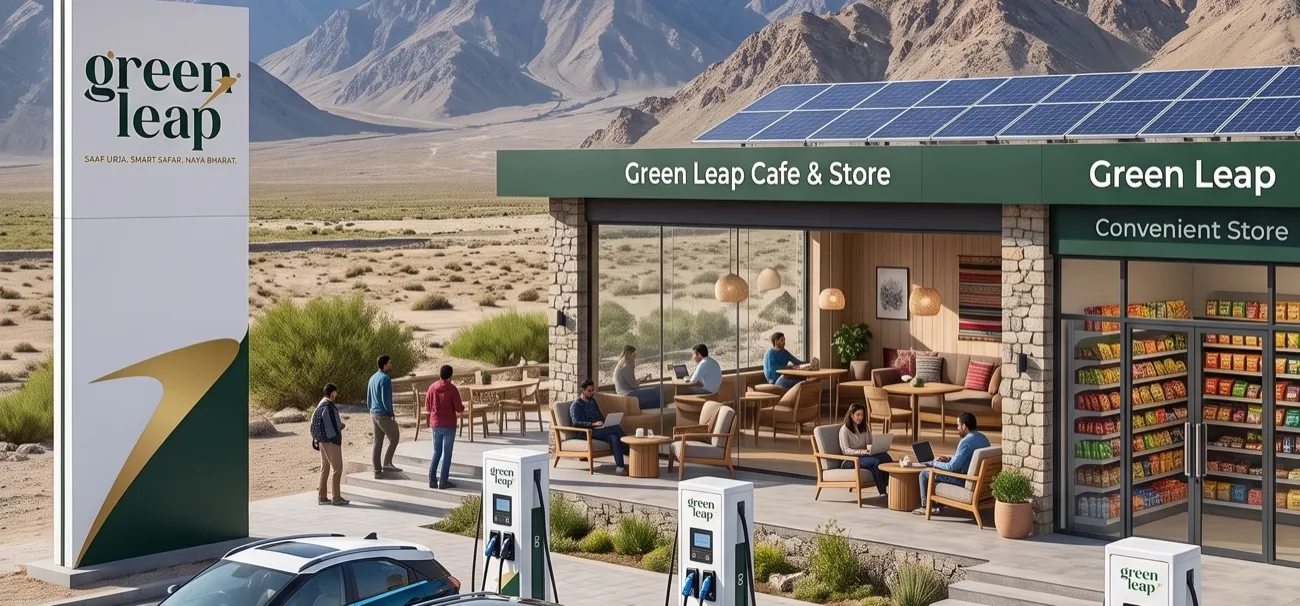
Solar over the bays. A battery behind the chargers. A small grid connection instead of a large one. The site makes and stores a good part of the power it sells, so it never needs the connection that causes the delay.
That is the company in one idea. The rest is execution.
One decision, three consequences
- A hub opens in weeks
- A light connection is a form and a wait. A heavy one is a transformer, a survey and a queue. We took the form.
- 15–30 daysto grid approval, against six to eighteen months
- It keeps running when the line drops
- On the corridors we are building first, the power goes out. The battery does not notice, and neither does the driver.
- Full speedthrough an outage, on stored power
- Every unit costs us less
- Sun and storage carry much of the load, so the cost advantage is not a launch offer. It holds for the life of the site.
- About halfwhat the grid alone would charge for a unit
Corridor by corridor, in that order
Each wave waits for the last one to be running. We would rather hold a corridor than plant flags across a map.
First
Karnataka and Maharashtra
Where the policy is warmest and the traffic is already there.
Then
Tamil Nadu and Uttar Pradesh
Longer corridors, and the volume to justify bigger hubs.
Then
Bihar and the central highways
The hardest grid in the country, which is the point.
We are raising to build the first corridors
Fifty sites are identified and the model behind them is built. The deck has the unit economics, the cost per hub, the payback, and what each state pays for. Ask and we will send it.